
The Current: A New BLOCK71 Newsletter
- 18/08/2025

BLOCK71 now has two homes in Japan!
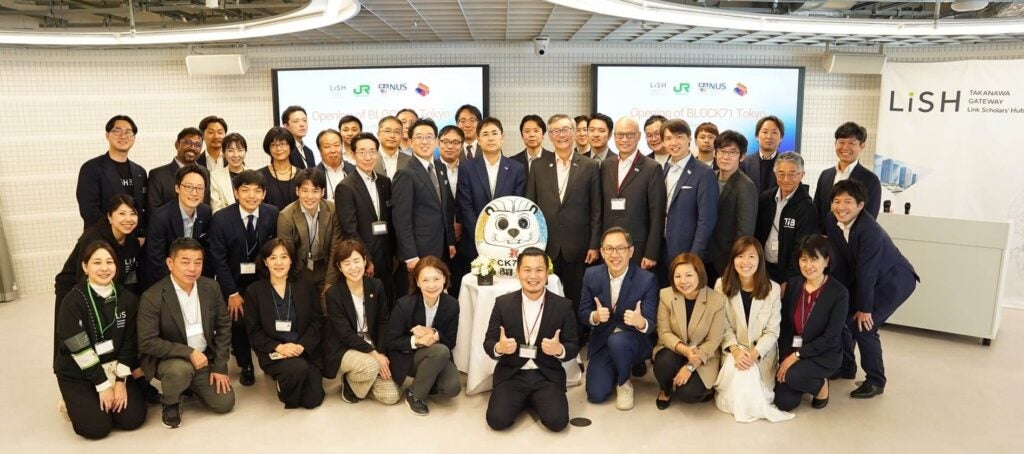
Located at the newly built TAKANAWA GATEWAY CITY, BLOCK71 Tokyo brings together Japanese partners from the local government, corporations, venture capital firms and universities to strengthen innovation ties between Singapore and Japan.
Following the opening of BLOCK71 Nagoya last year, we’ve recently launched our second outpost in Tokyo. This marks a significant step in deepening our global support for startups by connecting innovation hubs in Southeast Asia to East Asia.
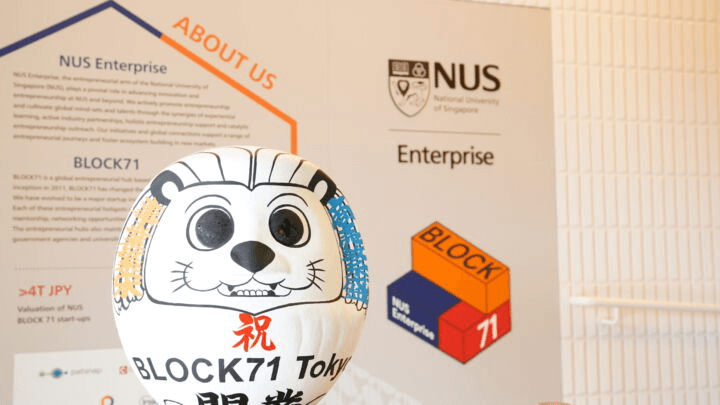
Hand-painted by a Japanese artist, the Daruma doll blends elements of Singapore’s mascot, the Merlion, to symbolise the strong collaboration between Singapore and Japan.
With the new Tokyo hub strategically located at TAKANAWA GATEWAY CITY, an emerging smart city powered by JR East, BLOCK71 Tokyo will support Southeast Asian startups looking to expand into Japan by tapping into strategic R&D, funding, and market access. We will also support Japanese startups expanding into Southeast Asia with Singapore as the gateway.
What this means for founders looking to expand

Caleb Khoo
CEO & Co-Founder
SalesHero
I worked from BLOCK71 Nagoya for a month and it was an amazing experience. The workspace at Station AI had a great air of collaboration and being immersed in that vibe was really motivating for me. I was also introduced to several local contacts for my business, and the key highlight was attending a meetup organised by SoftBank.
Which city you go to depends on your startup’s focus. If you are in advanced manufacturing, robotics or foodtech, Nagoya is for you. But if you are in fintech, blockchain/web3 or AI, then BLOCK71 Tokyo is perfect. Or you can always explore both offices since they are less than 2 hours apart by Shinkansen!
AI Engineer in Your Pocket? Lovable’s €14M+ Round Highlights a Development Revolution
AI platform Lovable is turning heads after closing a ~€14.3M (USD 15.7M) pre-Series A round led by Creandum (early Spotify backers) in late February. This Stockholm-based startup aims to be an “AI full-stack engineer,” empowering users to build websites, apps, and dashboards rapidly, even without deep coding skills.
For early-stage founders, especially those bootstrapping, the $17M ARR Lovable promises significant benefits: drastically reduced development costs, faster MVP launches, and the ability for non-technical founders to build directly.
It’s also a boon for indie hackers and experimental builders. The platform enables ultra-fast prototyping, makes solo full-stack development feasible, and lowers the barrier for launching multiple side projects or niche tools affordably.

Jonathan Low
CEO & Co-Founder
Zapi
Tools like Lovable can supercharge prototyping and reduce required time by about 80%. It’s certainly transformative and my startup is part of this shift too – we started with a focus on content sites but recently added backend capabilities so our users can build full apps.
But I’d caution that it’s still early days for this technology. A major limitation is that as projects and codebases increase in complexity, the AI’s effectiveness and accuracy tend to decrease.
This means while these tools are fantastic for lowering the barrier to entry and speeding up those initial builds, skilled developer intervention often becomes necessary for more sophisticated features, scaling, or refining larger applications.
Human expertise definitely remains crucial beyond that initial stage.
Navigating the AI HealthTech Maze: EU Rules Take Shape
As AI rapidly integrates into healthcare, regulators worldwide are intensifying efforts to ensure patient safety, accuracy, and reliability.
EU AI Act: High Bar for High Risk

The EU’s comprehensive AI Act is a game-changer. It classifies most AI systems used in healthcare as “high-risk.” Startups targeting the EU market must prepare for strict obligations phased in through August 2026. Key requirements include:
-
Transparency and explainability of AI models
-
High standards for data quality to minimise bias and errors such as hallucinations
-
Robust testing, documentation, and post-market monitoring
EU AI Act: High Bar for High Risk

Dr Nelson Lau
CEO & Founder
HealthBridge AI
Regulators stepping in is a necessary shift to ensure innovation doesn’t outpace responsibility. For those of us building clinical tools, we cannot move fast and break things — because that’ll harm the patients.
Regulation isn’t a roadblock — it’s a blueprint for building the trusted systems critical for patient care. At HealthBridge AI, we see such regulatory moves as a strategic framework for building trust and long-term defensibility. Our solution assists clinicians and we’re already building for strict requirements like transparency, explainability, data quality, and post-market surveillance according to this framework.
Category
News & Article